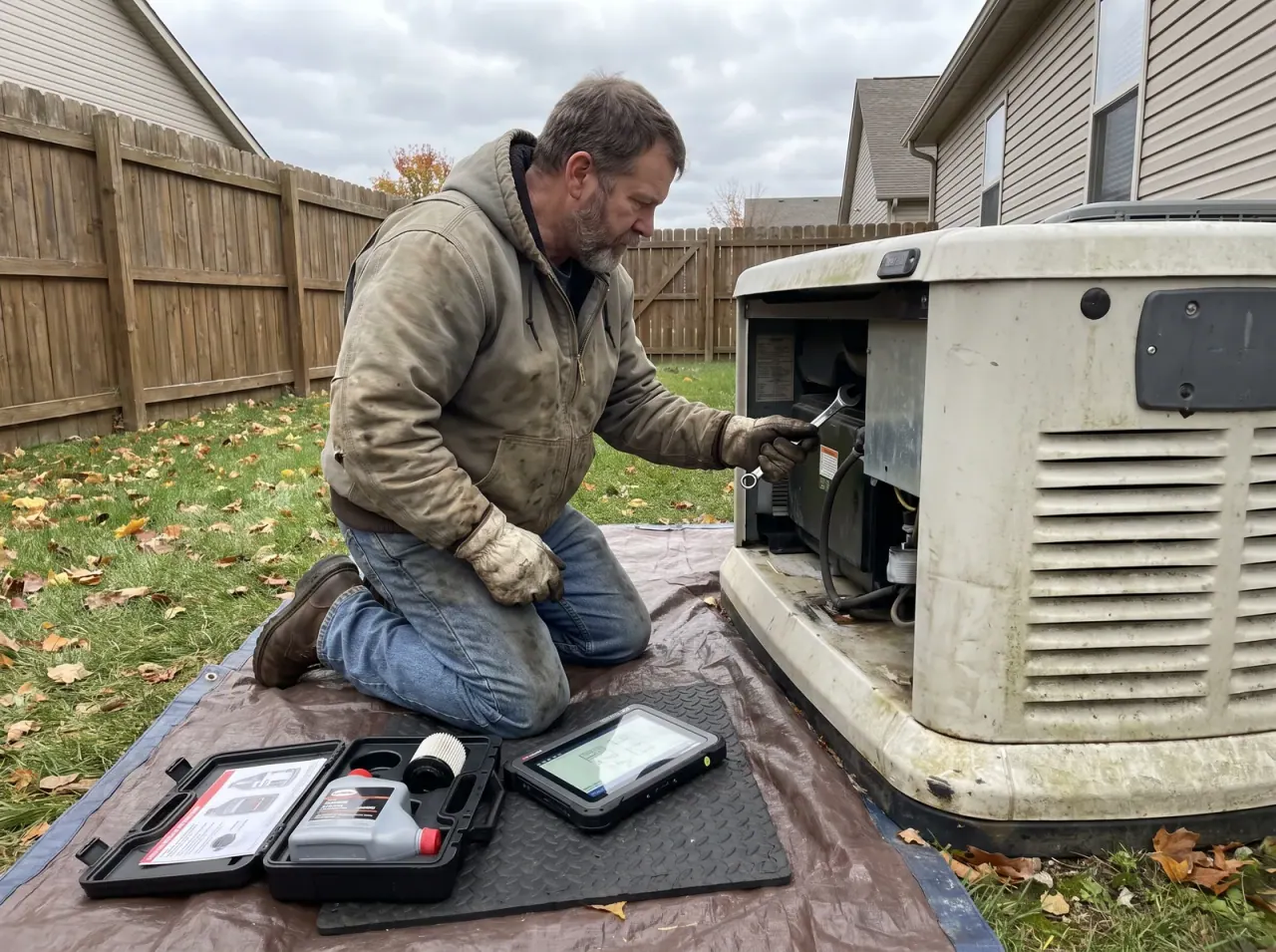
Find the schedule before buying a plan
Record your model and serial number from accessible documentation or the unit’s safe, visible identification area. Locate the current owner manual and warranty statement. A service plan that names the brand but not the equipment may leave important model differences unresolved.
Generac’s maintenance guidance explicitly tells owners to use their model manual. It also shows that initial service, calendar intervals and operating hours can affect the schedule. Do not copy an interval from a different generator simply because the enclosure looks similar.
If you inherited the equipment with a home purchase, start with what is known. An old receipt is evidence of the work written on it; a clean enclosure is not evidence that the required maintenance was completed.
Create one service record, not a folder of guesses
| Field | What to record | Why it matters |
|---|---|---|
| Equipment identity | Generator model/serial; transfer equipment details | Matches the right manuals and parts |
| Operating history | Total run hours and exercise settings | Separates calendar time from use |
| Last service | Date, hours, tasks and invoice | Shows what was actually completed |
| Next service | Due date/hours and who monitors it | Prevents a reminder from becoming an assumption |
| Known issues | Faults, failed tests or deferred work | Stops unresolved problems being forgotten |
You can use a notebook or a digital file. Do not store account passwords beside a publicly shared service worksheet. If a contractor uses remote monitoring, ask which alerts they receive and whether anyone is actively responsible for responding. An app notification is not a booked service visit.
Separate routine service from an outage routine
An exercise cycle, scheduled maintenance and operation through a long outage are different events. Routine maintenance helps preserve readiness; extended operation may create additional checks before the next calendar appointment.
Generac’s extended-use guidance addresses selected air-cooled models operating for long periods. Follow the applicable shutdown and maintenance instructions, or arrange professional help. Never inspect hot or moving components or add oil while a unit is operating.
Before an outage, identify who can perform owner checks permitted by the manual and who should be called for service. If the household cannot safely do those checks, the plan needs a different arrangement. A maintenance subscription should not hide that question.
Ask what the maintenance agreement actually includes
- Which tasks are performed for this exact model and which are excluded?
- Are parts, consumables and repairs included or separately charged?
- Is transfer-system testing included, and under what conditions?
- Who tracks run-hour service needs after an extended outage?
- Is remote monitoring included, and what response is actually promised?
- How are missed visits, access problems and discovered faults handled?
Ask for the report from each visit. “Serviced” is a less useful record than a task list with observations and any outstanding work. If the battery or another part is tested, the report should state the finding rather than assuming the part is good because the generator exercised.
Do not confuse a reminder with a diagnosis
A controller reminder may indicate a scheduled task; an alarm may indicate a fault. Read the message exactly and check the relevant manual. Clearing a reminder does not perform maintenance. Repeatedly clearing a fault does not establish that the underlying issue has been fixed.
Use the safe no-start observation guide if the system is not behaving as expected. If you see leakage, smell fuel or encounter another hazardous condition, keep away and follow the appropriate emergency response rather than continuing a checklist.
Keep readiness visible after the service visit
Before the contractor leaves, ask which operating mode the equipment is in, whether the agreed test was completed and whether any work remains outstanding. Keep the manuals, report and service contact together where the household can find them.
When you ask about maintenance, provide the model, last service date and run hours if available. If they are unknown, say so. For a new installation, the handoff checklist helps you obtain the records needed to maintain it from the first day.
Sources and scope
Prepared from the primary sources below. Equipment manuals and the responsible local authority control the requirements for your specific project; this page is a planning aid, not an installation procedure.