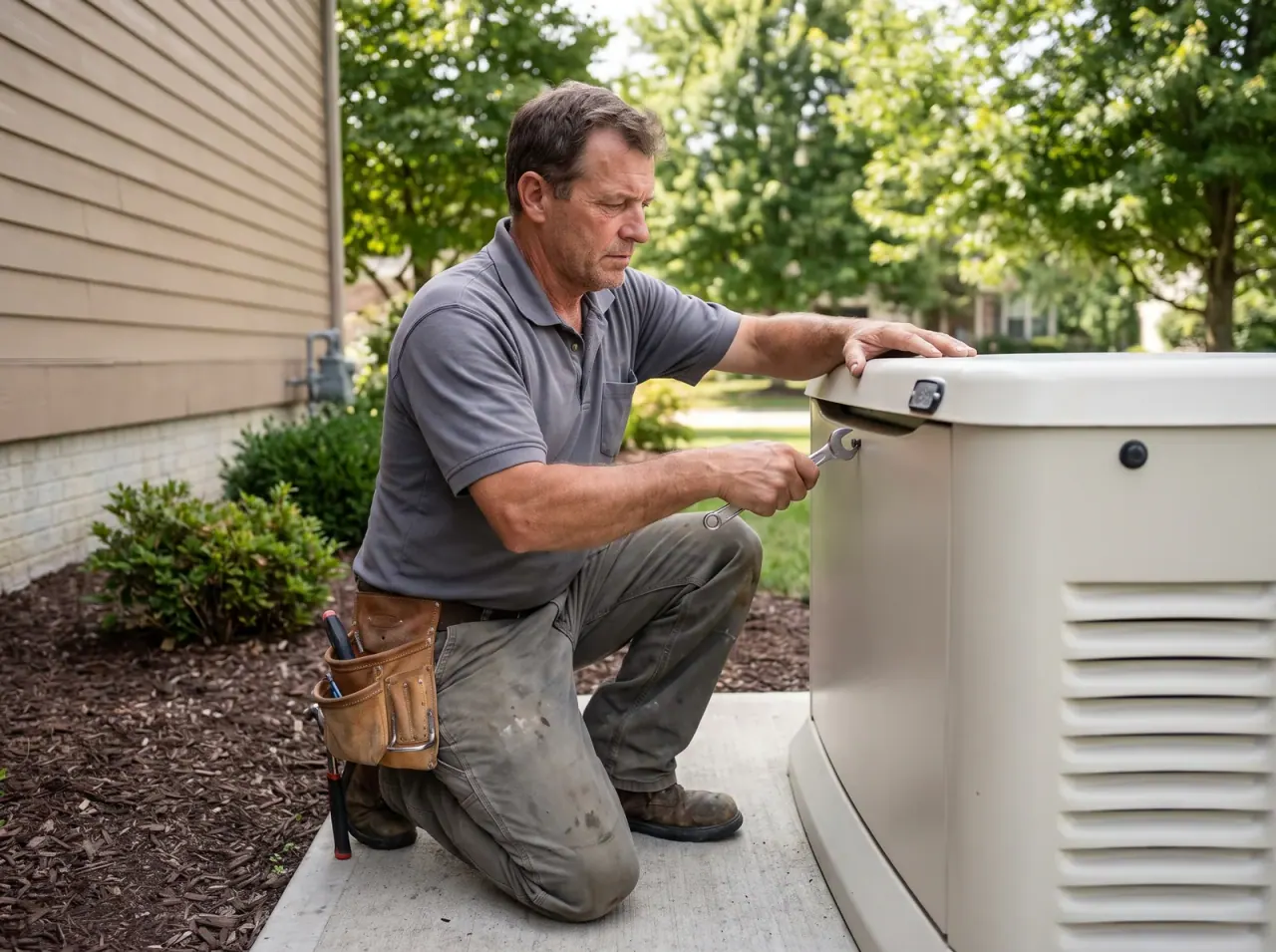
What a complete standby installation involves
A home standby system combines a generator, transfer equipment, a suitable fuel supply and a property-specific installation. Ask for these to be planned as one system. The objective is agreed backup coverage that can be demonstrated and maintained, with its limitations explained.
Use the load assessment worksheet to list heating, pumps, refrigeration and other priorities. Keep optional loads separate. A house’s floor area alone does not show the equipment that must start or run together.
Installation and electrical or fuel connections belong with appropriately qualified professionals. Generac’s installation guidance discusses the need to coordinate sizing, fuel supply and site requirements. This page is for preparing a project, not performing the work.
Choose the backup coverage first
| Coverage decision | What should be written into the plan |
|---|---|
| Essential circuits | Exact backed-up circuit list and any loads omitted |
| Whole-panel connection | Generator capacity assumptions and operating limits |
| Managed loads | Controlled equipment, priorities and restart behavior |
| Future equipment | What change requires a new assessment |
A whole-panel connection should not be sold as evidence that every appliance can operate at the same time. The transfer-switch guide explains why coverage and capacity need separate answers.
Review the site before agreeing on equipment
Compare the candidate location against the selected model’s installation manual and applicable requirements for your address. Include openings, property constraints, fuel routing, drainage and service access. A convenient spot by the meter is not automatically an approved location.
Prepare the placement checklist and consult the local planning directory. Do not assume the same permit categories or association conditions apply throughout Central Indiana. Ask the responsible authority about the proposed work.
Keep fuel work in the quote
Confirm that the natural-gas or propane supply is appropriate for the selected equipment and the property’s other fuel loads. Identify any work assigned to the utility or fuel supplier rather than the installation contractor. The fuel comparison shows what information to collect.
The proposal should name the generator model, its applicable fuel rating, transfer equipment, pad and site work, electrical work, fuel work, approval responsibilities and exclusions. Avoid a bid described only as “standard install.” Use the cost-factor guide and proposal checklist to align different bids.
Ask for a project sequence you can track
- Assessment: confirm priority loads, property conditions and fuel supply.
- Design and approvals: record the equipment, location, scope and required coordination.
- Installation: have qualified professionals perform the agreed electrical, fuel and site work.
- Commissioning: demonstrate the system under approved test conditions and record the result.
- Handoff: receive manuals, circuit coverage, operating limits and maintenance responsibilities.
These are planning stages, not promised lead times. Supply, approval and scheduling conditions need to be confirmed for the actual project. No completion date or quote turnaround is guaranteed on this site.
Compare brands through the same scope
Use the same load and site brief when discussing Generac, KOHLER or Cummins. Ask for the exact model documents and local service arrangements. The brand label alone does not resolve equipment availability, authorized-provider status or warranty terms.
If a home has a private well, sump pump or heat pump, include that equipment early. Those worksheets help expose the questions that a generic quote request misses.
Send an installation inquiry with useful detail
Share your city, current fuel source, equipment priorities and any known site constraints. It is fine to say that a model or measurement is unknown. Do not remove electrical covers or enter unsafe spaces to collect information.
Provider credentials, address-specific availability and final project scope must be confirmed before contracting. Use the handoff checklist to agree on what completion will mean for your home.
Sources and scope
Prepared from the primary sources below. Equipment manuals and the responsible local authority control the requirements for your specific project; this page is a planning aid, not an installation procedure.