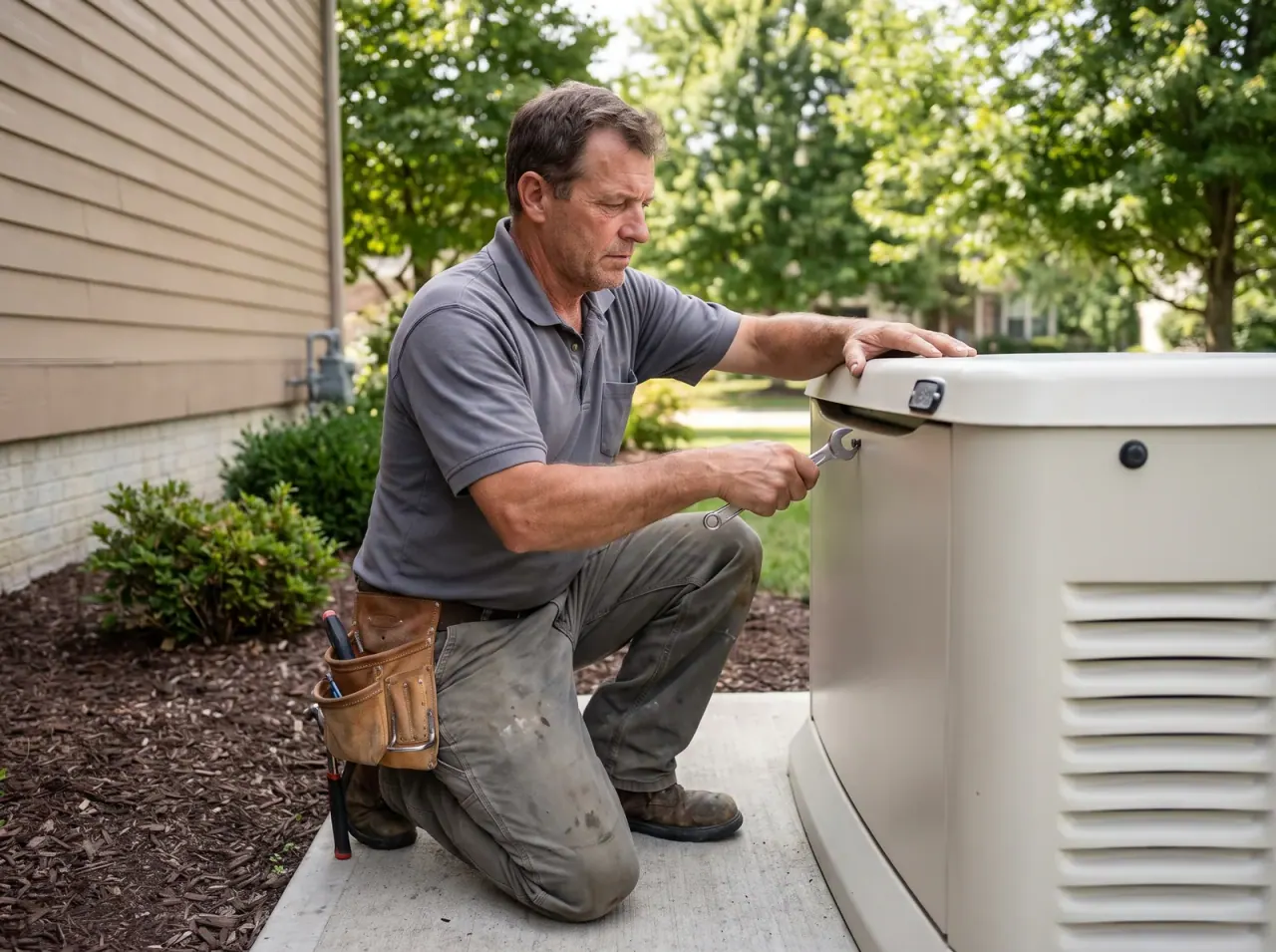
Start with the supply already at your property
Your first planning document is a description of the existing fuel supply. For natural gas, record the utility provider and the appliances already using gas. For propane, record the tank information you can obtain safely from supplier paperwork and the name of the company responsible for deliveries. Do not open meters, regulators or gas equipment to collect these details.
An existing gas furnace does not establish that the supply can also support the proposed generator. Generac’s installation planning guidance identifies adequate meter or tank capacity as part of the design. Ask the installer and fuel supplier to evaluate the combined demand before you agree to the equipment.
Make the comparison at the site level
| Question | Natural gas | Propane |
|---|---|---|
| What supports the fuel supply? | Utility service and a correctly designed meter/line arrangement | Tank, regulator, piping and delivery arrangement |
| What must be checked? | Available pressure and capacity for the proposed demand | Tank and supply performance for the proposed demand |
| How do you plan an extended outage? | Understand utility-supply limits and maintenance needs | Understand usable fuel, consumption and replenishment access |
| What belongs in the quote? | Any supply upgrade, line work and utility coordination | Tank-related work, line work, supplier coordination and site access |
This table is a question framework. It does not establish fuel availability at your address, a tank size, a pipe diameter or a guarantee of operation. Those decisions require the model documents and a professional evaluation.
Use the model rating for the proposed fuel
Look for separate ratings on the manufacturer’s specification sheet where provided. When two proposals use different fuels or models, align those ratings before comparing the kilowatt figures. The label on a product page can be a shorthand that does not explain your installation.
Ask for the specification sheet to be attached to the quote and the fuel choice written next to the generator model. That small detail prevents a later disagreement about the output the proposal was designed around. The sizing guide explains why output, motor starts and the circuit plan need to agree.
Treat propane runtime as a calculation with assumptions
A useful propane runtime estimate states the generator model, expected electrical load, usable fuel assumptions and consumption figure used. A tank’s nominal capacity is not automatically the amount available when an outage begins. Supplier advice is also needed for tank selection and cold-weather delivery planning.
For arithmetic only, suppose a plan assumes 100 usable gallons and a constant consumption of 2 gallons per hour. Dividing gives 50 hours. This is an invented math example, not a consumption claim or a promise for any generator. Change either assumption and the answer changes. Real consumption also varies with operating conditions and load.
Ask what loads the runtime estimate includes. Heating equipment and water heating should not disappear from a winter estimate merely because they make the number less attractive. A smaller essential-load plan may have different assumptions from a comfort-focused plan.
Plan access as carefully as capacity
- Can the supplier reach the tank under the expected site conditions?
- Which party owns the tank and maintains the relevant equipment?
- Who confirms the regulator, piping and other fuel components are appropriate?
- What inspection or approval is needed before startup?
Do not assume the electrical installer’s quote includes work owned by the gas utility or propane supplier. Ask each party to state its responsibility. The quote checklist includes a place for those exclusions.
A generator location convenient for wiring may be awkward for fuel routing. Use the placement worksheet to compare candidate sites without committing to one prematurely.
Bring these answers to an installation inquiry
Send the current fuel type, city, existing fuel appliances, and whether you already have propane supplier information. Include your outage load priorities and any placement constraints. Avoid guessing technical supply numbers that have not been verified.
Read standby installation planning for the wider project sequence. A good fuel decision leaves you with written scope, realistic operation limits and a clear owner for each supply task. It does not need an unsupported “unlimited runtime” promise.
Sources and scope
Prepared from the primary sources below. Equipment manuals and the responsible local authority control the requirements for your specific project; this page is a planning aid, not an installation procedure.